


Vacheron Constantin Métiers d’Art Tribute to the Animal Kingdom
For centuries, Vacheron Constantin has understood something that only the finest watchmakers bring to reality: the fact that a watch dial does not have to be merely functional. It can be a canvas. The Maison’s Métiers d’Art creations have long brought together hand engraving, enameling, guilloché, gem-setting, miniature painting and other decorative disciplines to create watches where the artistry is every bit as important as the mechanics within. But now, Vacheron Constantin leaps over tradition to delve into some of the most unusual art forms for the dials of its Métiers d’Art Tribute to the Animal Kingdom unique watches.
Here, the brand strays from gold sculpture into glass sculpture, from origami into three-dimensional origami and from fabric to hand embroidered multi-dimensional dials. It brings wood and feather marquetry to new dimensions and feasts the eyes on embossed and layered paper creations. Each of the six new watches is unique and just one of each is being created.
The concept of art on the dial has long been a major part of Vacheron Constantin’s work, especially with this new collection where it calls on crafts outside of the watch industry for dial art.
The concept may be an extension of the brand’s centuries-old love affair with metiers d’ arts, but it also fits naturally with its more recent commitment beyond the walls of the manufacture to cultural partnerships with the Louvre in Paris and The Metropolitan Museum of Art in New York. And for certain, it stems from the push for innovation and excellence that defines Vacheron Constantin today. This is a brand that celebrated its recent anniversary in its Manufacture by bringing its entire staff of employees to the party. What’s more, many of them rehearsed and rehearsed before presenting an unprecedented dance on the multi-level stairs of the workshops for guests to delight in.
No, Vacheron Constantin is not a stodgy old brand, despite being the world’s longest continually operating watch company. It is so dedicated to its motto, Do better if possible, and it is always possible, that it stretches all the limits –defying them time and again.

The new rotor of the Vacheron Constantin Métiers d’Art Tribute to the Animal Kingdom features tools of the trades used in this series of concept watches.
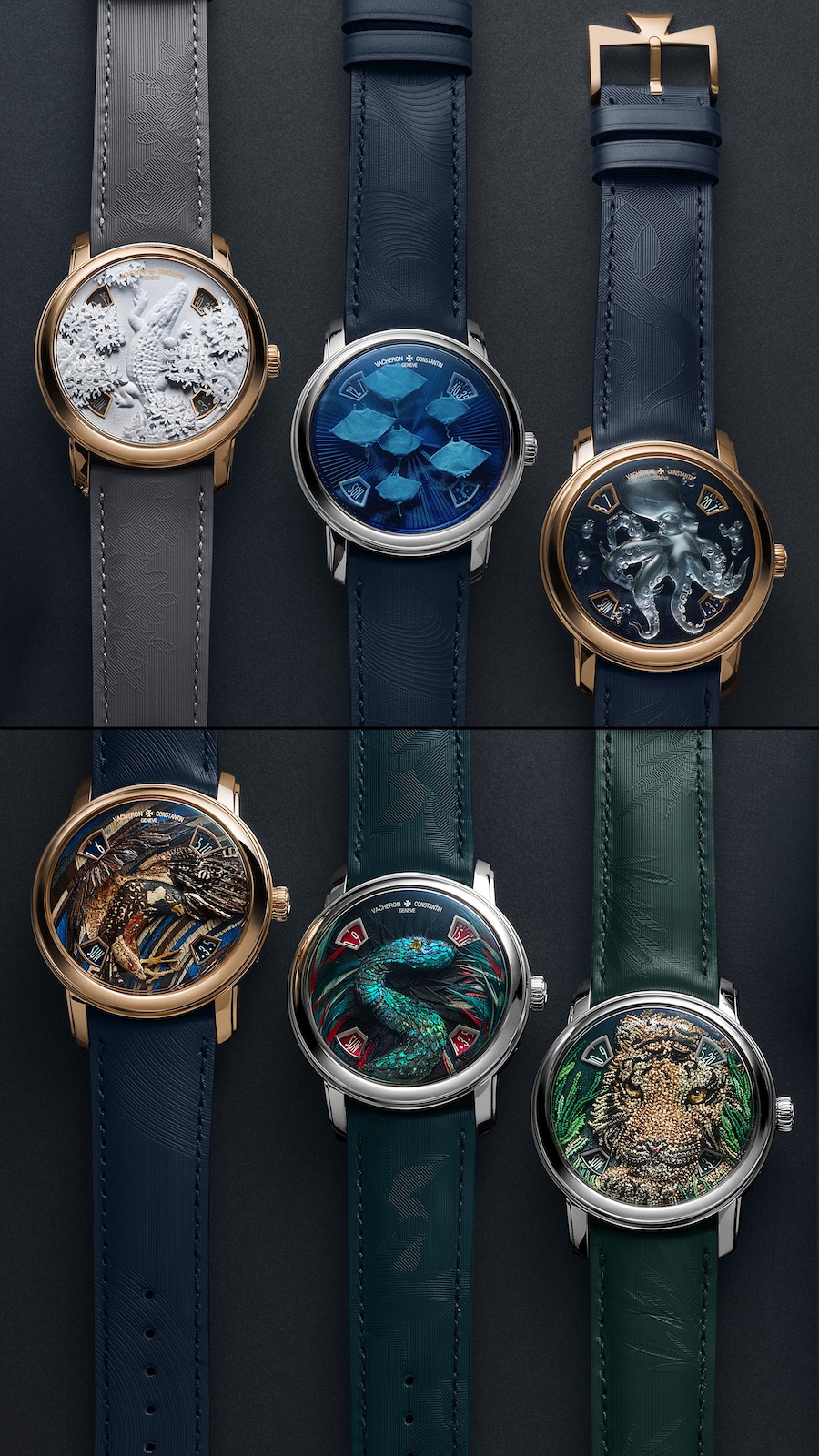
The new Métiers d’Art Tribute to the Animal Kingdom watches are the perfect example. The six concept watches are part of its “One of Not Many Crafts Programme,” an initiative designegd to preserve and perpetuate watchmaking crafts and skills. This project invites artisans whose work normally exists outside horology to see what happens when their craft is compressed onto a watch dial. This time the disciplines are glass sculpting, micro-origami, gold embroidery, paper sculpting, featherwork (plumasserie) and wood marquetry.
Tribute to the Animal Kingdom Project
It is easy to look at the finished watches and focus on the animals — a serpent, octopus, manta rays, tiger, crocodile and falcon — but the more interesting story is what had to happen before any of them could exist. All six artisans were forced to rethink familiar materials, invent new tools and find new work methods because the available space for their art was so unforgiving.
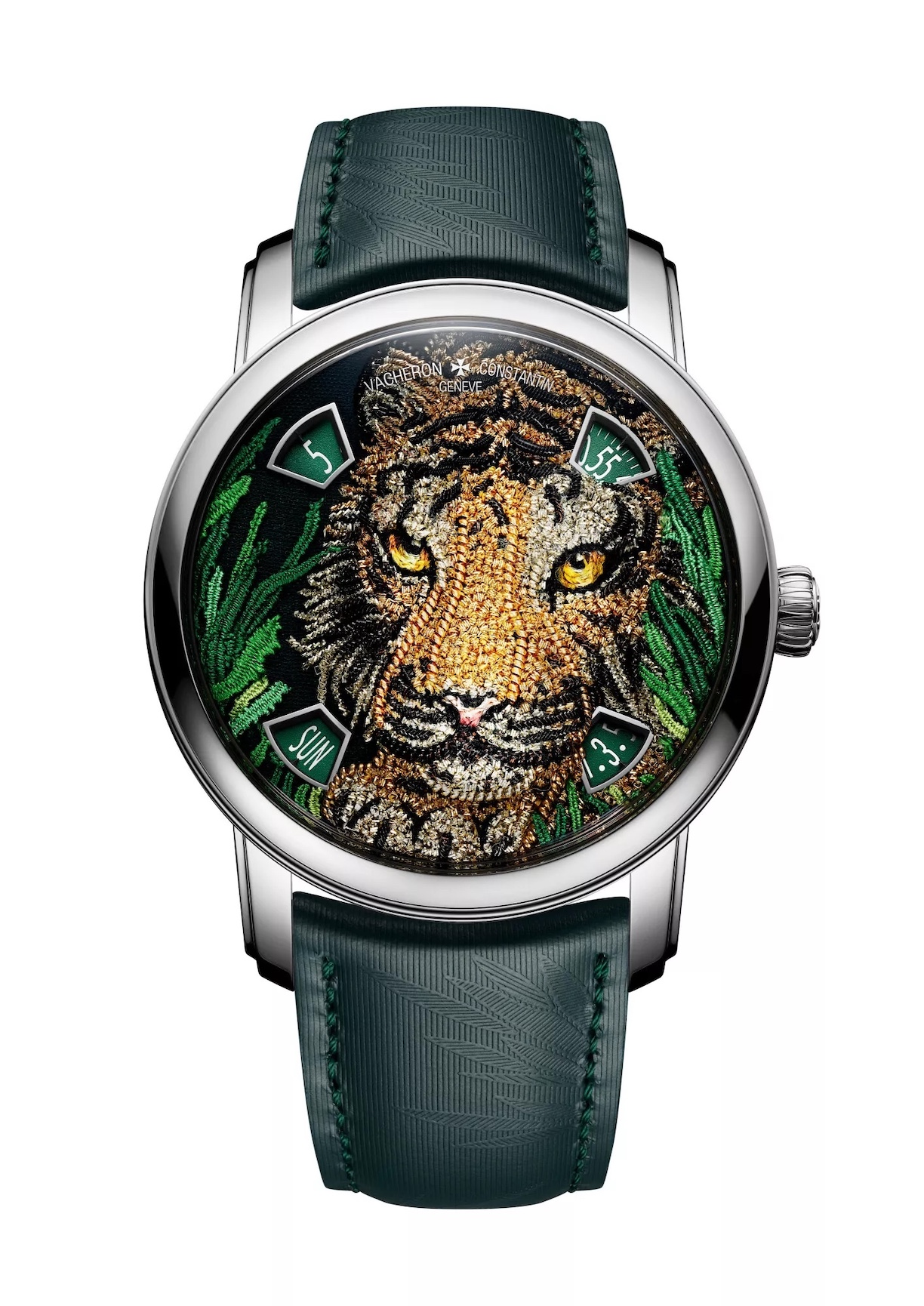
Vacheron Constantin Métiers d’Art Tribute to the Animal Kingdom Tigerbroidery
The cases measure 42mm in diameter and there is no more than four millimeters of height between the dial surface and the sapphire crystal. Crafts normally executed at a far larger scale suddenly had to work in fractions of millimeters. The project unfolded over years of research and prototyping. Materials that behaved predictably at normal scale became fragile, stiff, fibrous or visually unreadable when miniaturized.
Vacheron Constantin’s watchmakers and Métiers d’Art specialists worked with the independent artists to develop new solutions, tools and processes while ensuring that the result remained a fully functioning watch.
That collaboration is what makes this series particularly compelling: these are not simply artists decorating finished dials. In several instances, the physical architecture of the dial and the artistic technique had to evolve together.

Vacheron Constantin Métiers d’Art Tribute to the Animal Kingdom Feathersnake has more than 200 feathers hand placed on it.
While several of these artistic crafts — including featherwork, wood marquetry and origami — have found their way onto watch dials before, the Métiers d’Art Tribute to the Animal Kingdom watches push their execution into new territory. Here, Vacheron Constantin challenged six artists to rethink not only the scale of their work, but also the materials, tools and techniques they use to create it.
The result is six unique watches that take the concept of art on the dial to new heights.
Métiers d’Art Tribute to the Animal Kingdom Glassoctopus

Vacheron Constantin Métiers d’Art Tribute to the Animal Kingdom Glassoctopus
Perhaps the most immediately surprising watch is Métiers d’Art Tribute to the Animal Kingdom Glassoctopus. Italian glass artist Simone Crestani is accustomed to a material whose drama often comes from scale. Here, he had to do almost the opposite. The transparent octopus rises only 3.5mm above a dark blue, hand-guilloché 18-karat gold dial, yet it has a convincing sense of volume and movement, as though floating above the ocean floor.

The octopus on the dial of the Glassoctopus is a sculptured piece of glass. Vacheron Constantin Métiers d’Art Tribute to the Animal Kingdom
To create it, Crestani developed a new approach for translating a complex three-dimensional sculpture into what is essentially a 2.5-dimensional form. Tiny glass rods were melted and manipulated with tungsten tools, building the octopus gradually, piece by piece. Each tentacle and even the individual suckers had to be formed dot by dot because reheating threads of glass this fine could cause them to collapse into spheres through surface tension. Special tungsten tools were created to impress the face and suckers without remelting larger portions of the sculpture.
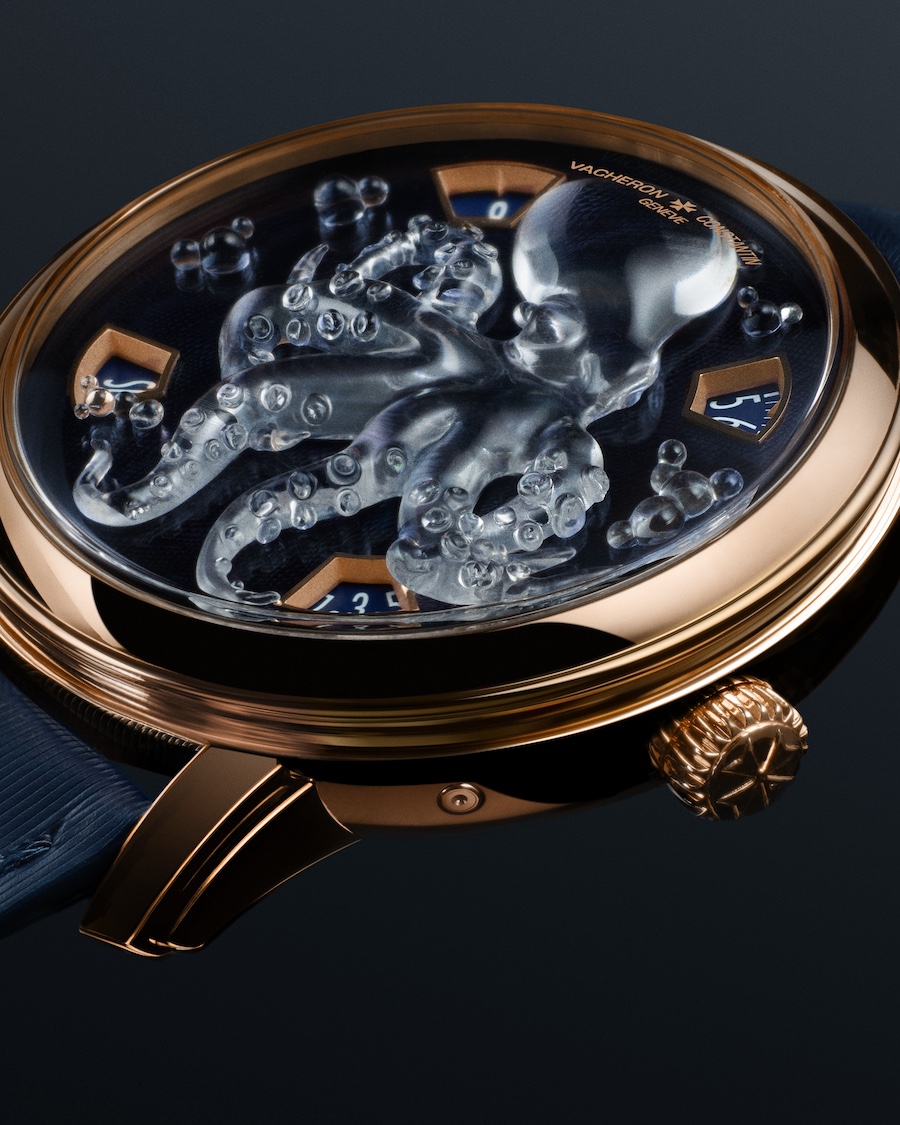
The glass is a three-dimensional work ofart.
Transparency added another problem. Every thickness and overlap changes the way glass refracts and magnifies what lies behind it. The apparent crossing of certain tentacles therefore relies partly on carefully constructed optical illusions. Even the four time-and-calendar apertures influenced the final pose: two tentacle sections pass just above windows that rise only two-tenths of a millimeter above the dial. Development lasted more than a year, beginning with prototypes in spring 2025. Four slightly different final octopuses were made before the version used for the watch was selected.
Métiers d’Art Tribute to the Animal Kingdom Oraygami
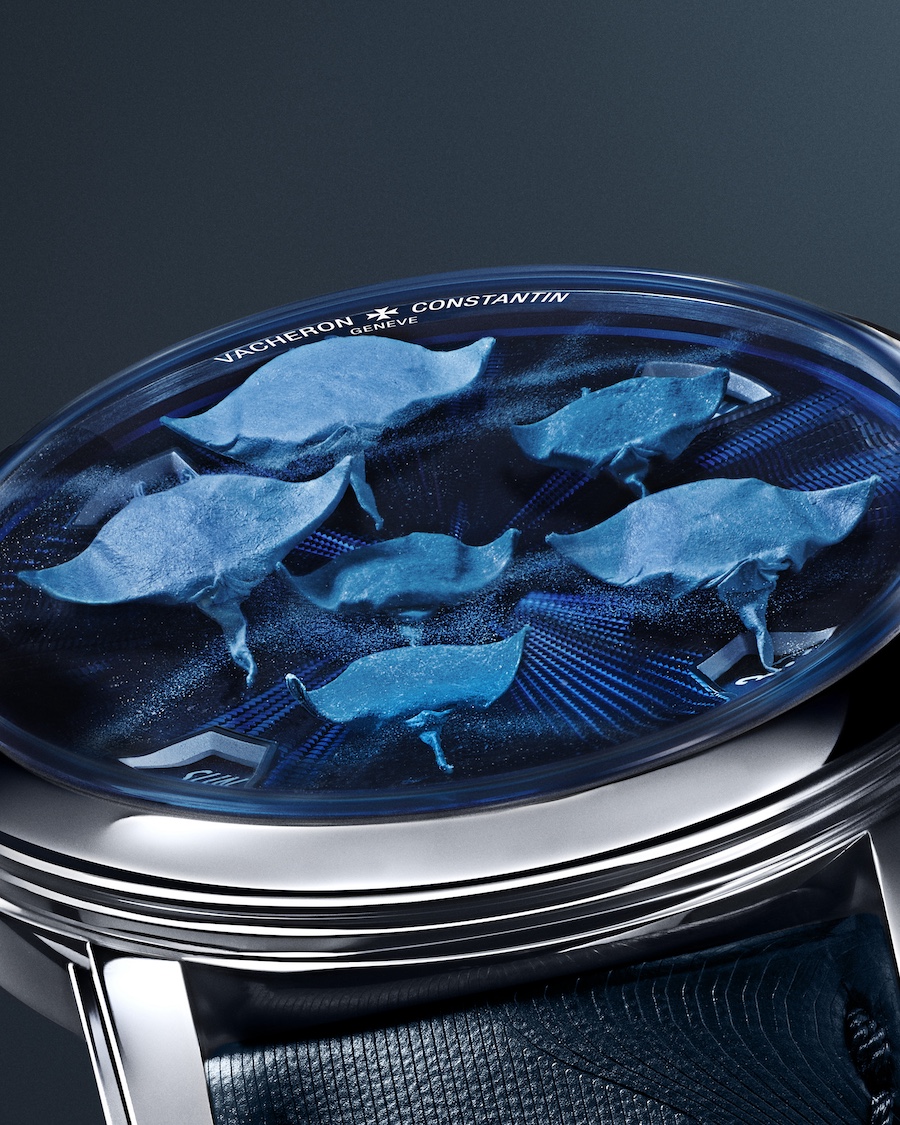
To create the 3D manta rays on this Vacheron Constantin Métiers d’Art Tribute to the Animal Kingdom watch, the artist studied actual manta rays, created a new folding technique and more.
Oraygami, created with micro-origami artist Anya Midori, features six manta rays folded from hand-colored Japanese paper and mounted on fine brass stems at different heights. Midori had to invent a new folding sequence after studying photographs and videos of real rays to understand their proportions and movement through water. The paper begins at only 9 to 12mm before folding, and the finished creatures measure roughly 6 to 8mm. They were folded using only fingers, fingernails and the tip of a toothpick — without magnification.
“This is probably the most significant project of my origami career so far,” says Midori, who notes that it was also the first time she had been involved from the very beginning of the creative process rather than simply executing an existing idea. The project also pushed her into experimenting with dyeing the paper herself and developing entirely new folding sequences.
The development stretched from the first conversations in summer 2024 through completion in 2026, with some of the earliest manta rays requiring as much as six hours each to fold.
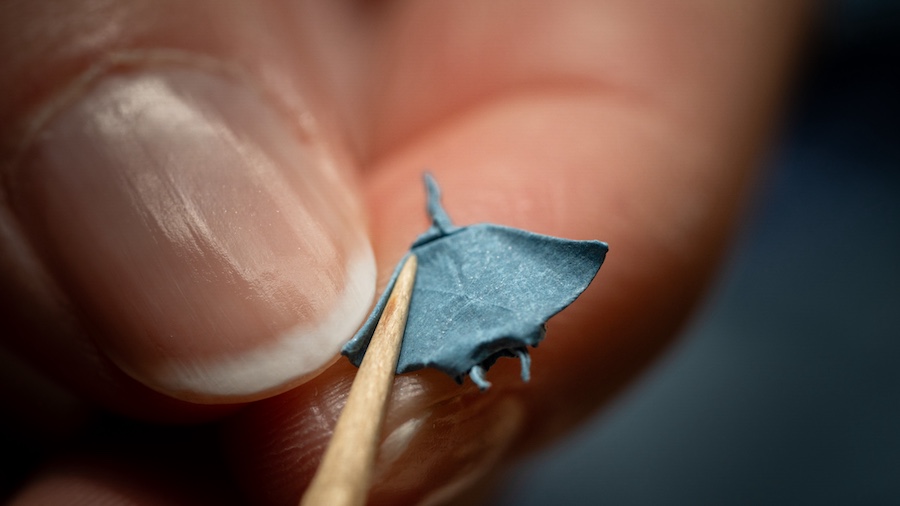
Each individual manta ray is hand folded and finished for this Vacheron Constantin Métiers d’Art Tribute to the Animal Kingdom Oraygami.
“In origami, artists usually work from existing folding sequences developed by other masters, but for this project, I had to invent my own model from scratch. I spent a long time studying photographs and videos of real rays to understand their proportions and the way they move through water before translating those observations into folds.”
Métiers d’Art Tribute to the Animal Kingdom Papercroc
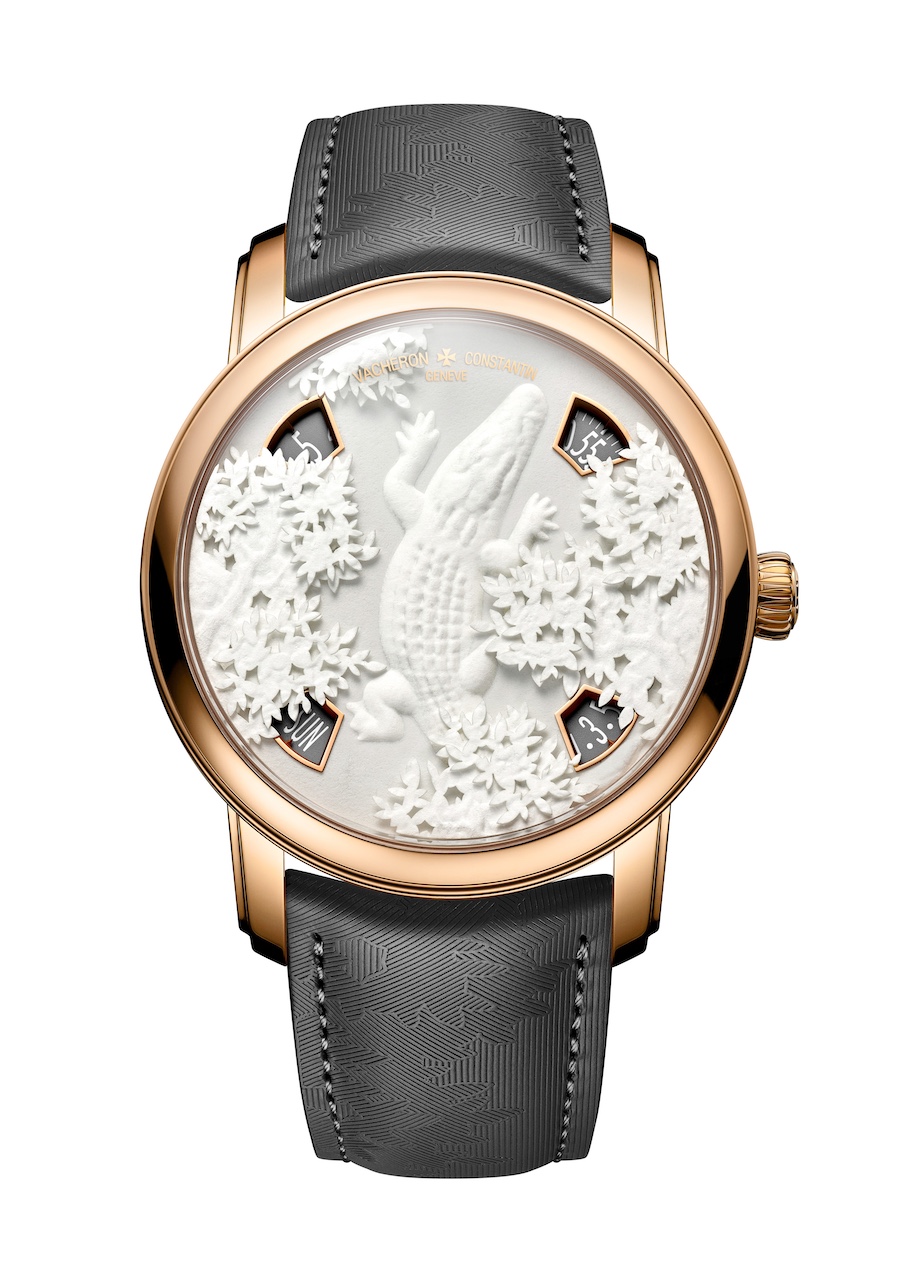
Vacheron Constantin Métiers d’Art Tribute to the Animal Kingdom Papercroc uses embossing on cotton paper.
Papercroc, by Paris-based paper artist Marianne Guély, is almost ghostlike by comparison. Its crocodile and surrounding vegetation are entirely white, formed from acid-free cotton paper of two different weights.
For Guély, who had long imagined bringing her chosen medium into watchmaking, the collaboration fulfilled a longstanding ambition. “This project represents the fulfilment of a dream I had carried with me for many years,” she says.
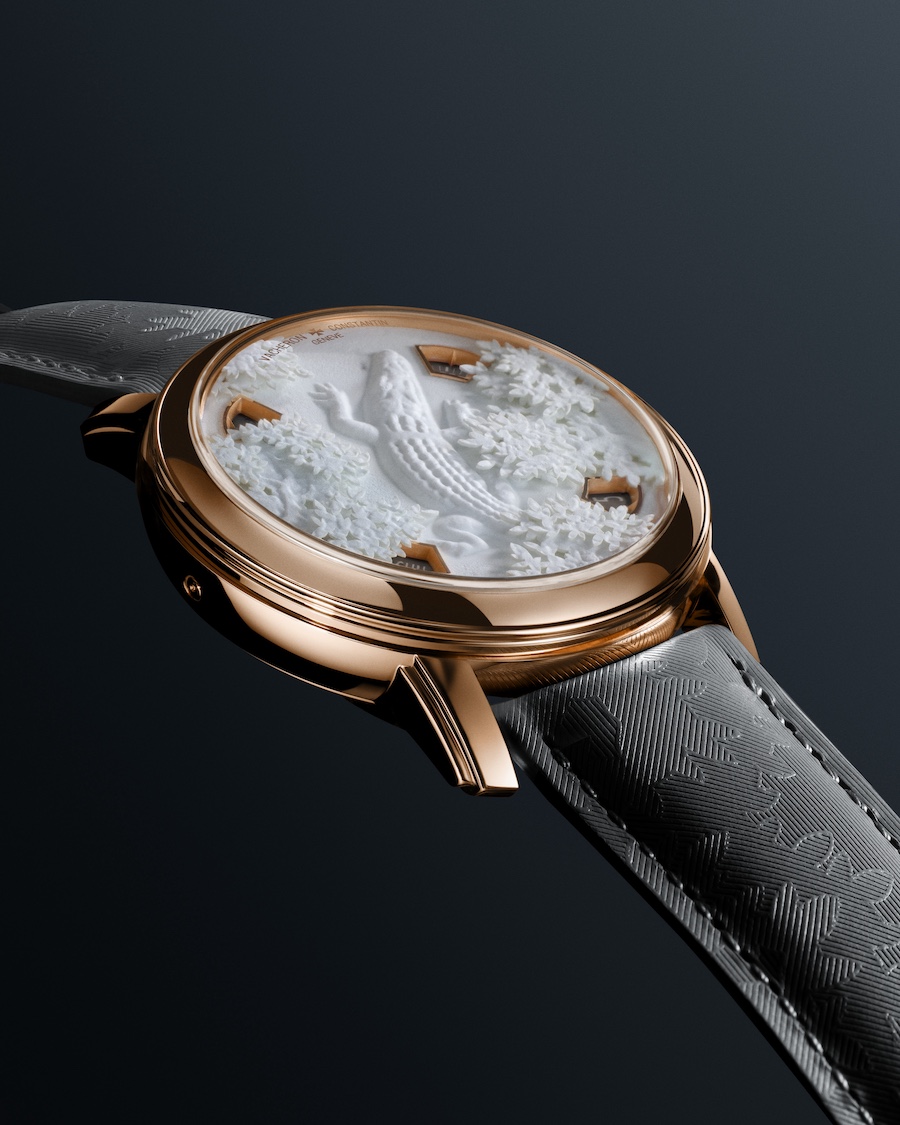
Vacheron Constantin Métiers d’Art Tribute to the Animal Kingdom Papercroc from angled view.
Embossing, laser cutting and hand assembly create a composition only about three millimeters high. Heated brass matrices engraved with scales and foliage were pressed into the paper to create relief, while repeated experiments were needed to keep the natural fibers from fraying and to make the vegetation legible at microscopic scale. The monochromatic result relies on light and shadow rather than color to reveal the animal.
Métiers d’Art Tribute to the Animal Kingdom Woodenwings
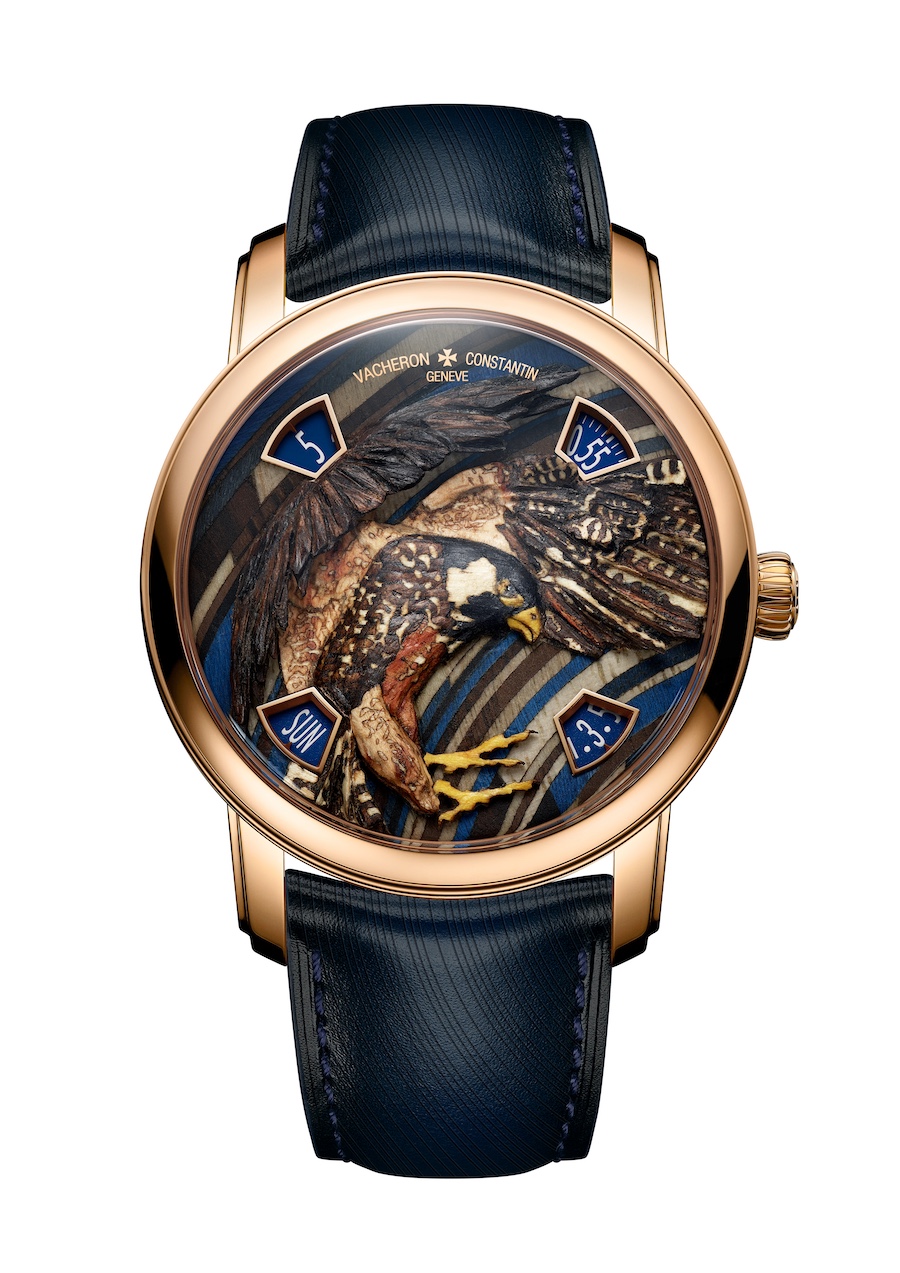
Vacheron Constantin Métiers d’Art Tribute to the Animal Kingdom Woodenwings
Woodenwings brings the material warmth of wood to the dial. Artist Anna Le Corno constructed a falcon using 12 species, including smoked eucalyptus and dyed birch. Rather than conventional flat marquetry, the dial combines circular marquetry in the background, sculpted layered marquetry for the bird’s body and a “feather-by-feather” technique developed specifically for the wing. Traditional woodworking tools were too large, so Le Corno turned to surgical-style scalpels, microscopic carbide bits and custom sanding tools, much of the work carried out under binocular magnification. The entire composition rises only about three millimeters, with the wing cantilevered over the dial and its feather tips approaching the sapphire crystal.
Métiers d’Art Tribute to the Animal Kingdom Tigerbroidery
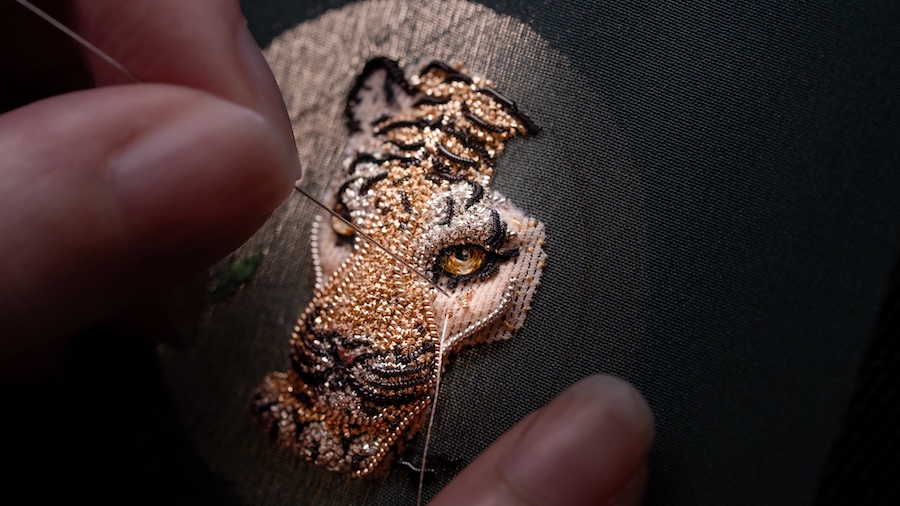
Vacheron Constantin Métiers d’Art Tribute to the Animal Kingdom Tigerbroidery
Then there is Tigerbroidery, which may be one of the most technically unexpected watches of the group. Laura Baverstock’s tiger is not painted, engraved or enameled. It is embroidered. The animal is built from 9-karat yellow- and white-gold embroidery wires, with ceramic-coated black wires creating the stripes. The surrounding jungle is worked on specially dyed green silk, with grasses stitched in multiple shades of Japanese silk.
Using actual gold presented problems of its own. Traditional goldwork embroidery typically relies on gilt wire with only a small amount of gold, but Vacheron Constantin wanted a more precious material. Increasing the gold content changed the flexibility and behavior of the wire, so new miniature tools had to be developed to twist and coil it. Needles as fine as 0.25mm were made for the metallic threads. The tiger’s body contains individually cut pieces of gold wire measuring less than a millimeter, while its eyes alone use ten shades of silk. A perforated titanium dial plate was developed so the embroidery could be stitched directly onto the watch structure. The completed dial required about 210 hours of work.
Métiers d’Art Tribute to the Animal Kingdom Feathersnake
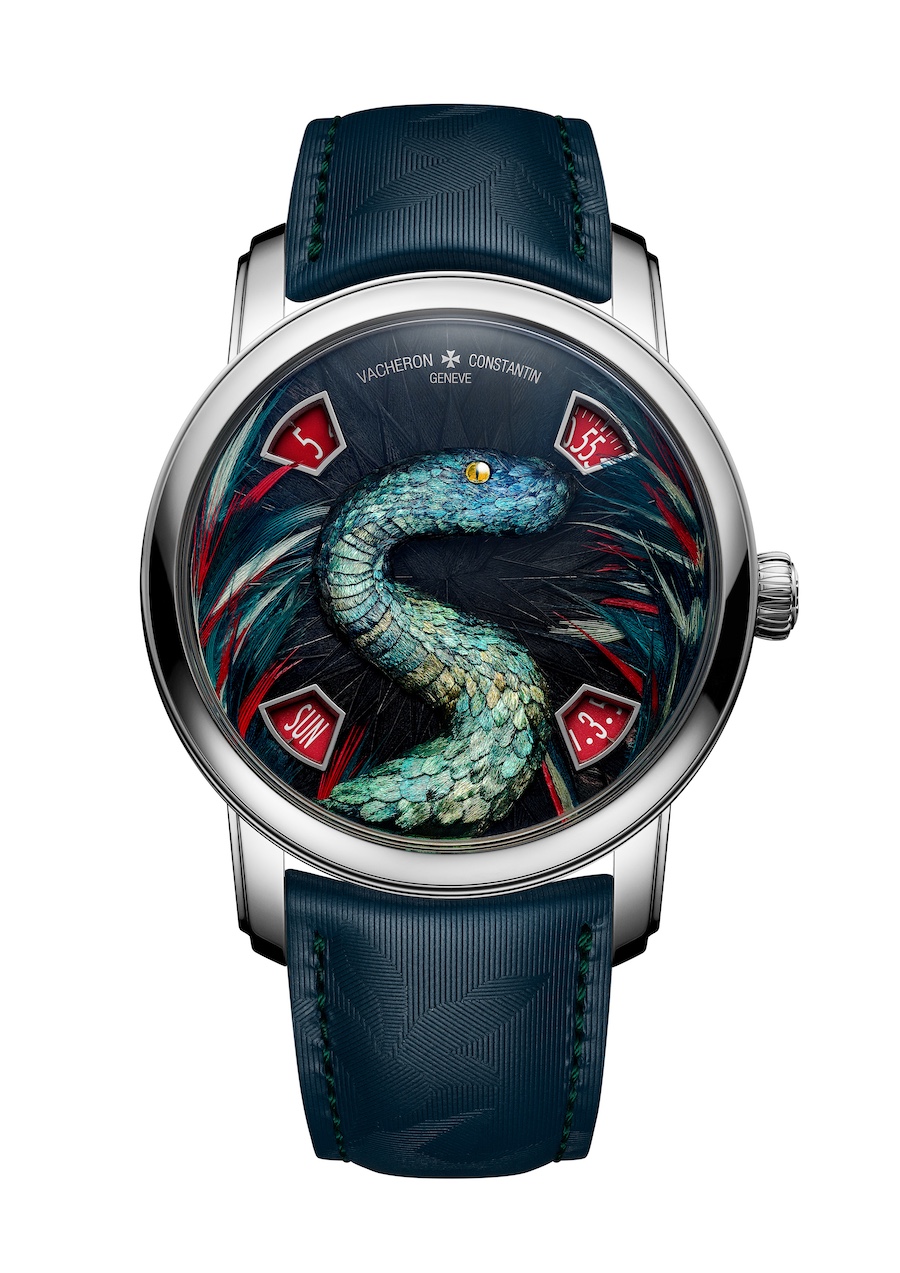
Vacheron Constantin Métiers d’Art Tribute to the Animal Kingdom Feathersnake
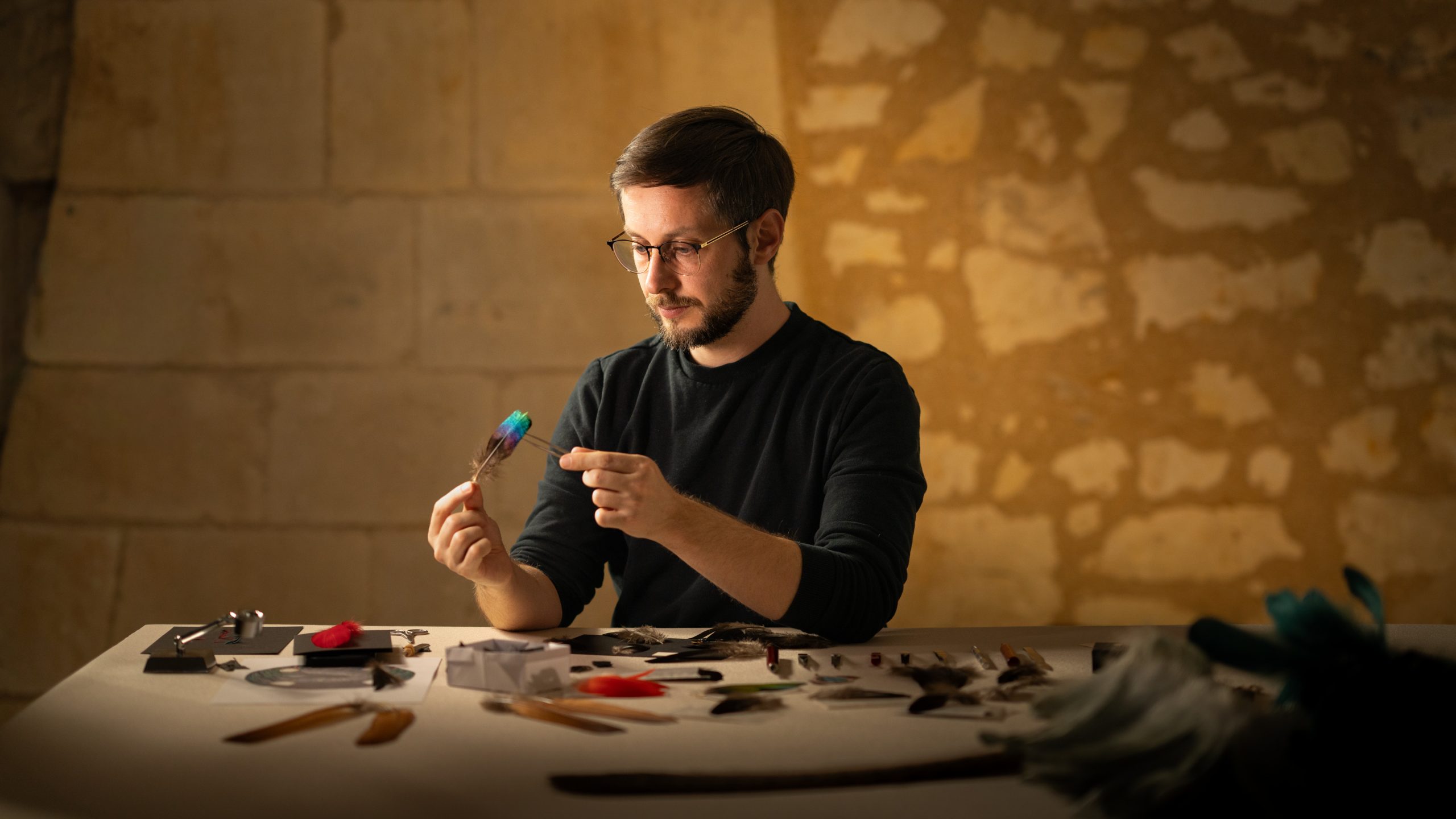
Feathersnake takes an entirely different route to three-dimensionality. Feather artist Julien Vermeulen created an imaginary serpent whose shimmering blue-green surface is composed of more than 200 tiny pieces cut from just seven rare Lophophore feathers. Goose feathers form the surrounding foliage and background, while a specially developed metal applique beneath the snake helps give the creature volume without pushing it beyond the roughly three millimeters available.
At this scale, even the tools had to shrink. Vermeulen fashioned a custom micro-scalpel from a reshaped needle and refined a sewing needle so that it could deposit microscopic points of glue. The feather pieces were mounted on silk paper to make precise cutting possible. The work took approximately 250 hours including research and prototyping, and Vermeulen has said the concentration was so intense that he could work on it for only about four hours a day. The snake’s eye — almost a punctuation mark amid all that featherwork — is made of 18-karat gold and enamel.
Inside the Métiers d’Art Tribute to the Animal Kingdom watches
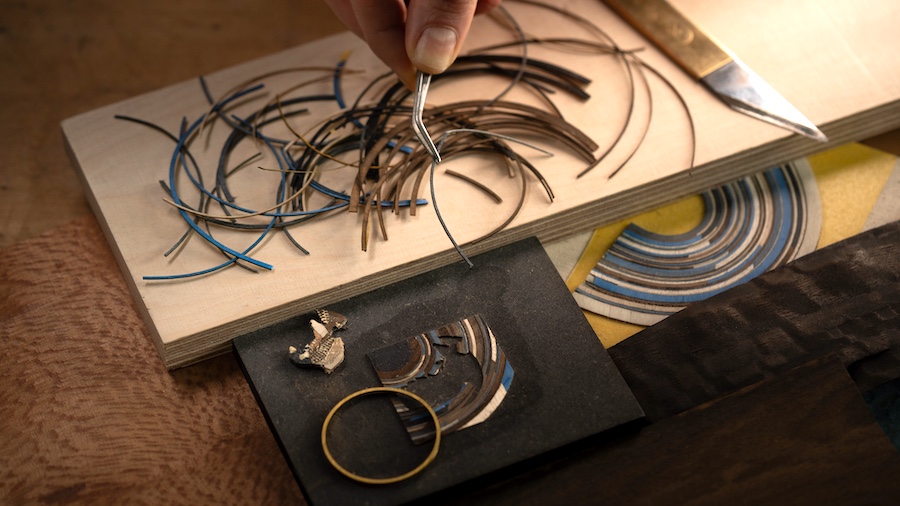
Vacheron Constantin Métiers d’Art Tribute to the Animal Kingdom Woodenwings uses more than 20 different kinds of woods.
What makes the six watches possible as watches — rather than miniature artworks with hands placed on top — is the self-winding Calibre 2460 G4. Vacheron Constantin uses four peripheral apertures to display hours, minutes, day of the week and date, leaving the center of the dial free of conventional hands. The 31mm movement comprises 237 components, operates at 4 Hz and offers approximately 40 hours of power reserve. For the series, it is fitted with a 22-karat gold oscillating weight that is specially designed and hand-engraved with motifs inspired by artisans’ tools.
The cases are all 42mm by 12.9mm and water resistant to 3 bar, with Feathersnake, Oraygami and Tigerbroidery housed in 18-karat white gold, while Glassoctopus, Papercroc and Woodenwings use 18-karat 5N pink gold. Each watch also receives a calfskin strap embossed with a motif that extends the visual language of its dial — leaves, tentacles, waves, foliage or stripes.
Ultimately, these six unique watches prove that even after centuries of Métiers d’Art watchmaking, there are still boundaries to push — and new ways to transform a watch dial into an extraordinary miniature work of art.