




Vacheron Constantin Metiers D’ Art Tribute To Great Civilizations
In the quiet halls of the Louvre, history rarely feels distant. Stone figures carved thousands of years ago still project authority, grace and power with astonishing immediacy. Standing before them, you sense not only the greatness of lost civilizations, but also the enduring ability of human hands to create something that transcends time.
That is precisely what makes the continuing partnership between Vacheron Constantin and the Louvre so compelling. Since 2019, the two institutions have worked together not simply to reproduce art on watches, but to reinterpret some of humanity’s most important cultural achievements through the lens of haute horlogerie and métiers d’art craftsmanship.
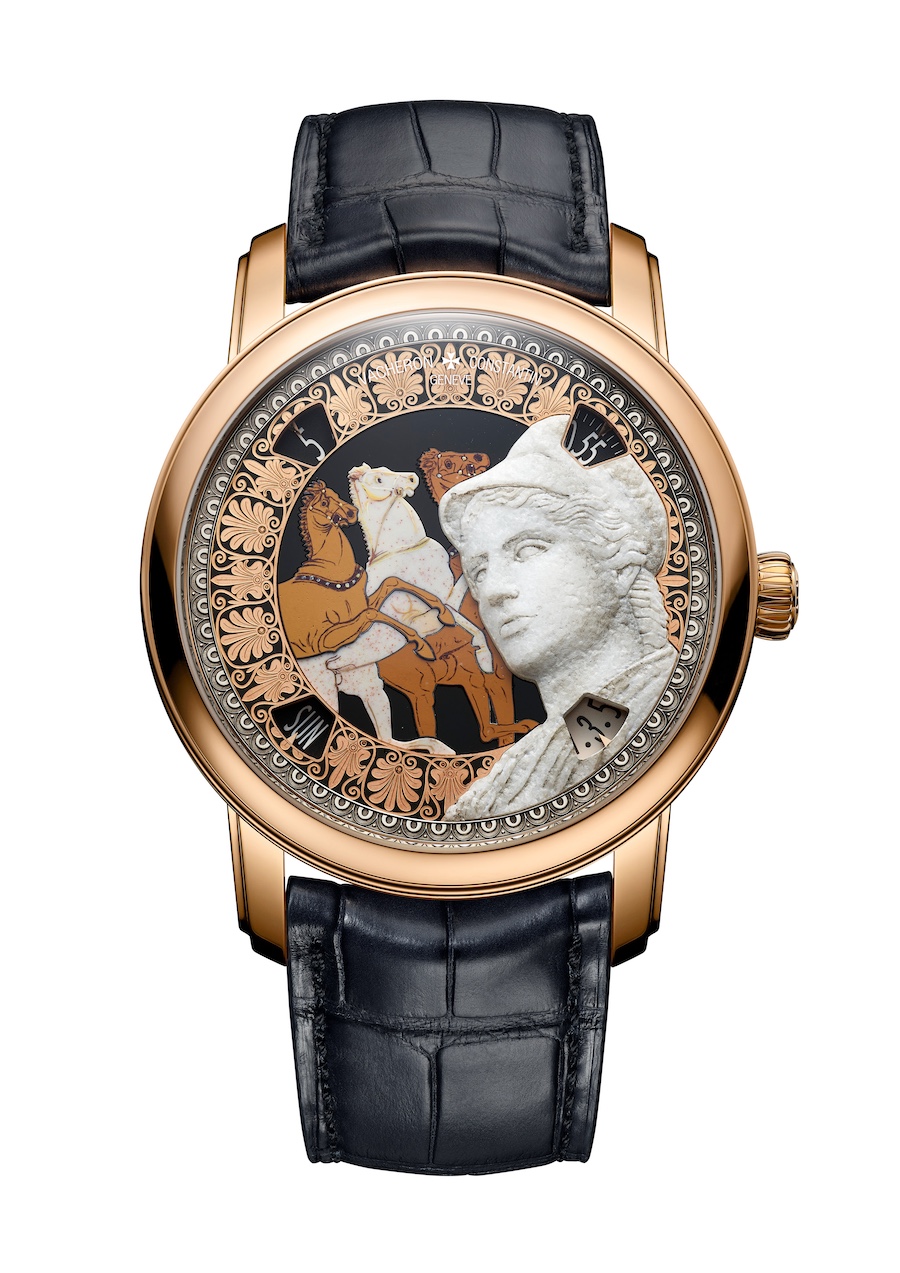
Vacheron Constantin X The Louvre Athena de Velletri Tribute to the Great Civilizations: Ancient Greece, 480-323 BC
I was fortunate enough to join Vacheron Constantin on its first launch in 2022 of this Tribute to Great Civilizations Métiers D’ Art journey and it was enlightening. Being in the Louvre when it is closed to others is both exhilarating and humbling at the same time. The scope of art, of masterpieces made so many centuries ago, can be overwhelming, so you have to wonder how the master artisans at Vacheron Constantin and the Louvre select which pieces of work will go down in history on the dial of a watch.
I was enthralled with those first watches, and the four new versions of the Métiers d’ Art Tribute to Great Civilizations watches continue that original mission, honoring the past in timepieces made to endure centuries more. The civilizations represented now: Pharaonic Egypt, the Neo-Assyrian Empire, Ancient Greece and Imperial Rome. Each in pieces that blur the lines between miniature sculpture, painting, mosaic work and watchmaking.
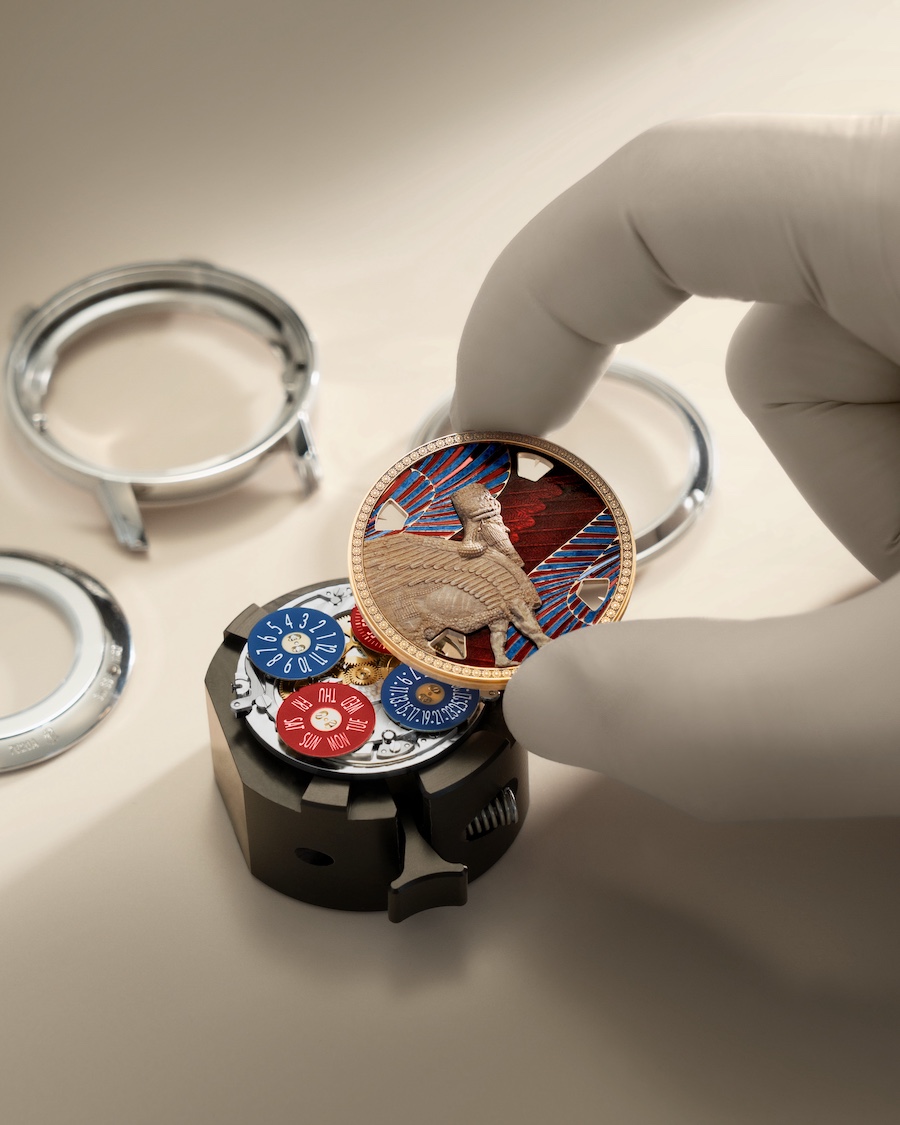
The making of the Vacheron Constantin X The LouvreTribute to Great Civilizations Lamassu de Sargon II Neo-Assyrian Empire 934-609 BC
Like the first series unveiled in 2022, these new watches are powered by the Manufacture Caliber 2460 G4/2, a self-winding movement whose four window displays for the hours, minutes, day and date eliminate the need for central hands. The result is an unobstructed dial — a blank canvas that allows Vacheron Constantin’s artisans extraordinary freedom.
And freedom is exactly what these watches embody. Each 42mm piece is constructed almost like an archaeological tableau assembled in layers. Glyptic, stone marquetry, micro-mosaic, engraving, enameling, gilding and miniature painting are combined with astonishing precision. In many cases, the stones used are identical in origin and type to those found in the original Louvre masterpieces being honored. The work is not decorative for decoration’s sake. It is deeply researched, historically grounded and painstakingly executed. More importantly, it is emotional.

Vacheron Constantin Bust d’Akhenaton, Egyptian new Kingdom 1500-1000 BC
The new Buste d’Akhénaton watch, based on the Egyptian New Kingdom (1500-1000 B.C.) may be the most alluring of the series. The elongated face of the revolutionary Egyptian pharaoh emerges from hand-carved Sinai limestone sandstone with an almost spectral presence. Viewed from a slightly low angle, Akhenaten appears introspective yet commanding, his features softened by hand-applied patina that creates remarkable depth and realism. Surrounding him are intricate friezes inspired by ancient Egyptian jewelry and pectorals, executed in engraved turquoise, chrysoprase, red mother-of-pearl and sodalite. The dial feels less like a watch face and more like an excavated relic carefully preserved under sapphire crystal.
The Lamassu de Sargon II (from the Neo-Assyrian Empire (934-609 BC) captures a very different energy – full of color and stature. Inspired by the monumental Assyrian guardian figures that once protected the palace of Sargon II, the dial possesses an unmistakable sense of strength and movement. The winged human-headed creature, sculpted in stone and hand-patinated, rises from a richly textured background of red agate, dumortierite and translucent enamel. The feather motif beneath the figure creates an almost architectural depth, recalling the painted reliefs of ancient Mesopotamia. Even reduced to wristwatch scale, the Lamassu retains its imposing authority. This is my particular favorite.
The Athéna de Velletri (Ancient Greece (480-323 BC) features a sculpted bust of Athena in luminous Paros marble — the same material as the original sculpture — in three-quarter profile, against a dramatic backdrop of galloping horses — created from onyx and mookaite stone, then enhanced with miniature painting to emphasize movement and musculature. There is tremendous visual appeal in this watch: restraint against complexity, stillness against motion.
With a golden backdrop, the Tibre de l’Iseum Campense recalls Imperial Rome ( 27 BC-476AD). The Roman river god is sculpted in marble and sits opposite a stone micro-mosaic that blooms in color and fruitfulness. Inspired by a Roman floor mosaic, it is assembled from thousands of tiny fragments of jasper, chrysocolla and opaline. The gold base beneath translucent enamel creates a softly glowing backdrop that gives the entire dial warmth and dimension. It is a watch that invites prolonged viewing because every angle reveals another detail.
Collectively, these watches represent something else of significance in watchmaking: patience. Each dial requires between 120 and 220 hours of work, often involving multiple artisans whose crafts must align with micron-level precision. A mistake late in the process could erase weeks of labor. Yet that vulnerability is also what gives these pieces their soul. They are not industrial products masquerading as art. They are art — executed through centuries-old techniques that survive because houses like Vacheron Constantin continue to invest in preserving them.
The movement deserves mention, as well. The Geneva Hallmark-certified Caliber 2460 G4/2 is finished to the standards expected of the Maison, with Côtes de Genève, beveling, circular graining and a beautifully engraved oscillating weight depicting the Louvre’s eastern façade. Even the reverse side reinforces the dialogue between watchmaking and cultural heritage.
Limited to just 15 pieces each, these new Métiers d’ Art Tribute to Great Civilizations watches are not about trend or even traditional notions of luxury. They exist in a different category altogether, one that preserves history as effectively as any museum — all on a tiny canvas.